Champions League Odds & Betting Markets Comparison
 Available in US
Master Champions League betting with our complete odds guide. Learn bet types, strategies, and find the best bookmakers for UCL wagering in 2026.

Table of Contents
Why this Champions League betting guide gives you an edge
Let’s be real for a second. The Champions League isn’t just football’s biggest club competition – it’s a betting goldmine if you know what you’re doing. But here’s the problem: most betting guides treat you like an idiot or overwhelm you with jargon that doesn’t actually help you make better bets.
This guide is different. I’ve spent years analyzing Champions League betting markets, tracking thousands of matches, and yes, making plenty of mistakes along the way. What you’re about to read isn’t theory from someone who’s never placed a bet – it’s practical knowledge earned through real money on the line.
Whether you’re betting on the group stages or the knockouts, whether you’re backing favorites or hunting value in underdogs, this guide will give you the framework to make smarter decisions. Not every bet will win – that’s gambling – but you’ll understand why you’re making each bet and what factors actually matter.
What Makes Champions League Betting Unique?
The Champions League operates on a completely different level than domestic leagues. Teams face unfamiliar opponents, travel across time zones, and juggle competing priorities. A team fighting relegation domestically might go full strength in Europe for the prestige. A runaway league leader might rotate heavily once they’ve secured qualification. These dynamics create opportunities that don’t exist in regular league play.
The new tournament format for 2024/25 onwards has changed everything. More matches, different incentives, altered qualification dynamics. Understanding these changes isn’t optional – it’s essential for finding value in the betting markets.
Understanding Champions League Odds
Before we dive into specific betting strategies, you need to understand what odds actually represent and how bookmakers set them. This isn’t just academic – understanding odds is fundamental to finding value.
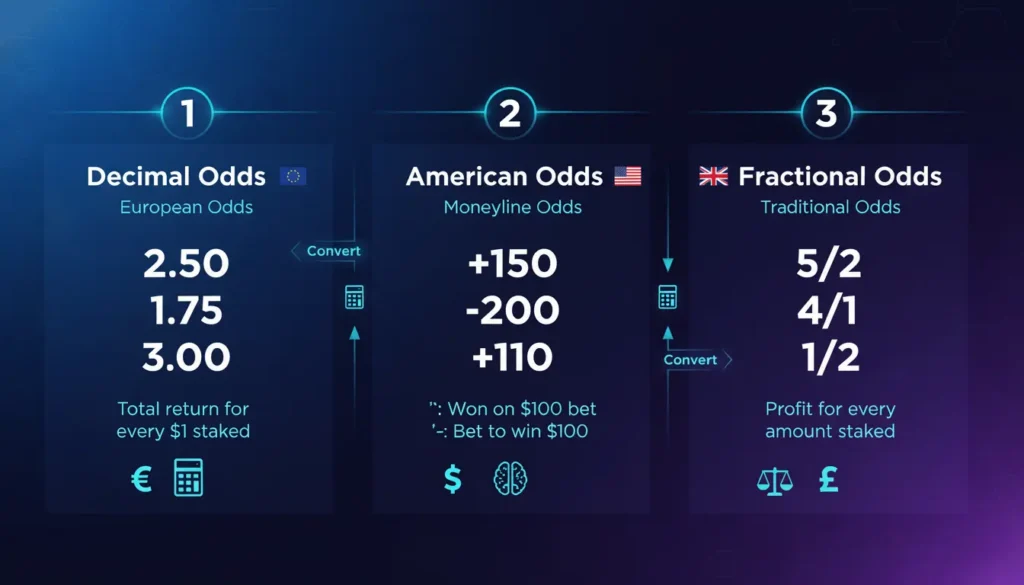
Decimal Odds (European Format)
This is the cleanest, most intuitive format. The number represents your total return for every unit bet. Odds of 2.50 mean you get back $2.50 for every $1 wagered, including your stake. Your profit is $1.50.
Decimal odds make calculating returns dead simple, which is why they’re the standard across Europe and increasingly popular in the US. When you see Real Madrid at 1.75 to beat PSG, that’s decimal odds telling you they’re the favorite.
American Odds (Moneyline)
American odds use positive and negative numbers. Negative odds (-200) show how much you need to bet to win $100. Positive odds (+150) show how much you’d win from a $100 bet. It’s less intuitive but once you get used to it, the format actually provides quick mental math for favorites and underdogs.
Here’s the trick: negative odds below -200 are strong favorites (you’re risking a lot to win little), while anything above +300 is a significant underdog (high risk, high reward).
Fractional Odds (UK Format)
Fractional odds (5/2, 3/1, etc.) show your potential profit relative to stake. Odds of 5/2 mean you win $5 for every $2 bet, plus your stake back. They’re traditional but increasingly being replaced by decimal odds even in the UK because they’re harder to calculate and compare.
The Hidden Margin: How Bookmakers Make Money
Here’s what most casual bettors don’t realize: the odds you see include the bookmaker’s margin (also called “vig” or “juice”). In a truly fair market, if you add up the implied probabilities from the odds on all possible outcomes, they’d equal 100%. But bookmakers price markets so they total 105-110%.
That 5-10% difference is how they guarantee profit regardless of the outcome. When Real Madrid plays Bayern Munich, fair odds might be Madrid 2.10, Draw 3.50, Bayern 3.80. But the bookmaker offers 2.00, 3.30, 3.60. Those slightly worse odds on every outcome ensure they profit.
Your job as a bettor is finding situations where you believe the true probability is better than the odds suggest. If you think Madrid has a 55% chance of winning but the odds imply only 50%, that’s value. Do this consistently, and you’ll profit long-term despite the bookmaker’s margin.
Popular Bet Types for UCL
The variety of available bets on Champions League matches is staggering. You can bet on everything from the match result to the number of throw-ins. But 80% of your betting should focus on a handful of bet types where you can actually gain an edge.
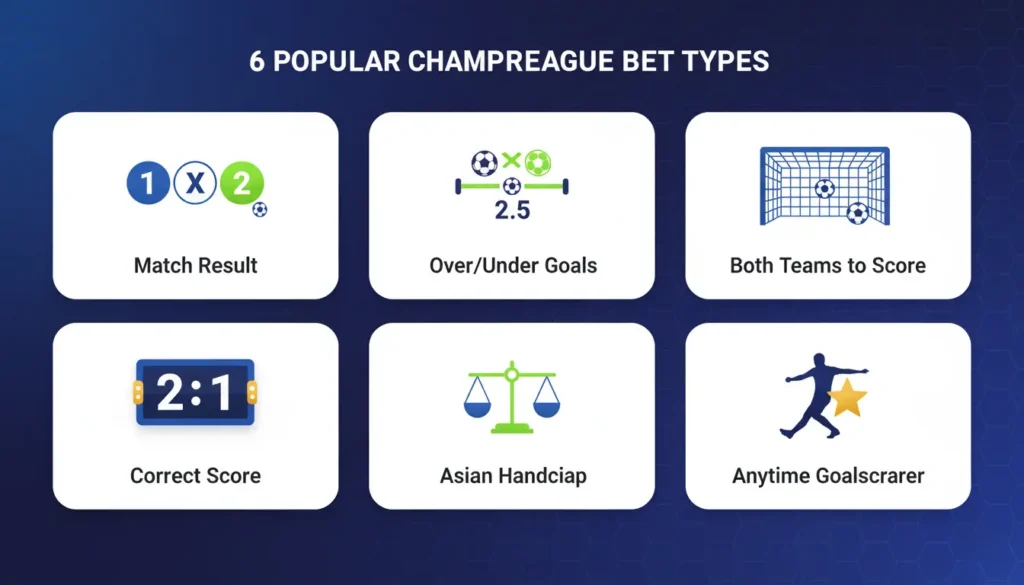
Match Result (1X2)
The simplest bet: who wins, or will it be a draw? In Champions League, draws are more common than domestic leagues because teams are more evenly matched and often play conservatively, especially away from home. The knockout rounds essentially eliminate draws (extra time and penalties decide winners), but in the group and league stages, backing the draw in certain matchups can offer value.
Key insight: in the first leg of knockout ties, teams often settle for draws, particularly away sides. The second leg is where things open up.
Over/Under Goals
Betting on whether the total goals scored will be over or under a specific number, typically 2.5. This is one of the best markets for finding value because it’s less dependent on which team wins and more about overall game flow and tactics.
Champions League matches trend lower-scoring than domestic leagues. The average is around 2.7 goals per match, compared to 2.9-3.1 in top domestic leagues. Defensive solidity matters more at this level. When two elite defensive teams meet, Under 2.5 goals often provides value even if bookmakers set similar odds to domestic fixtures.
Both Teams to Score (BTTS)
Will both teams find the net? This bet has become increasingly popular because it keeps you invested throughout the match. One goal from each side wins your bet, regardless of the final score.
In Champions League, BTTS hits around 51-53% of the time, but the odds rarely reflect this accurately. The key is identifying mismatches in defensive quality versus attacking prowess. A team with a strong attack but shaky defense? BTTS candidate. Two defensive powerhouses? Probably not.
Correct Score
Predicting the exact final score is tough, which is why the odds are lucrative. But it’s also why it’s generally -EV (negative expected value) for most bettors. The bookmaker’s margin on correct score bets is massive, often 20-30%.
That said, certain scorelines hit more frequently than statistics suggest they should. 1-0, 2-1, and 1-1 account for a disproportionate share of Champions League results. If you’re going to bet correct score, focus on these common outcomes in matches where you have strong conviction about the game flow.
Asian Handicap
This is where sophisticated bettors play. Asian Handicaps eliminate the draw by giving one team a virtual head start. If Manchester City has a -1.5 handicap against a weaker opponent, they need to win by 2+ goals for your bet to win.
The beauty of Asian Handicaps is they often offer better value than straight win bets because they force you to consider winning margins. A heavy favorite might be 1.30 to win outright but 1.90 to win by 2+ goals. If you believe they’ll dominate, that’s significantly better value.
There are also split handicaps like -0.75, which is actually two bets: half your stake on -0.5 and half on -1.0. These reduce variance and are perfect for Champions League, where close matches are common.
Interactive tool
Signal or Noise: xG Regression & Bonus Value
Two numbers that fool bettors — a hot streak that is really variance, and a bonus that is really a bill.
Flattered by
–
–
Actual GD / match
–
xG-based GD / match
–
Sample
–
Attack
Defence
Is the gap bigger than luck?
–
–
Scoring now
–
Scoring if it reverts
–
Conceding now
–
Conceding if it reverts
–
The test behind the gauges: goals arrive roughly as a Poisson process around xG, so the natural spread of goals over a sample is the square root of xG. A team on 8 xG will land anywhere from about 5 to 11 goals on luck alone. Only once the gap clears roughly 1.6 times that spread does it stop being noise — and over a short European campaign that bar is high enough to disqualify most hot streaks.
What the bonus is actually worth
–
–
Turnover required
–
Break-even rollover
–
Bets to clear
–
What the same bonus is worth at other rollovers
Expected cost of clearing
–
Value retained
–
Implied price per bet
–
Swing either way
–
Where bonuses really go wrong: the rollover multiple is rarely the problem. What quietly destroys a promotion is a minimum-odds clause — being forced onto longer prices pushes you into markets carrying two or three times the margin, and the same playthrough then costs you several times as much. Read the minimum-odds line before you read the headline number.
Anytime Goalscorer
Betting on a specific player to score at any point in the match. The odds vary dramatically based on the player’s scoring record and position. Strikers get short odds, midfielders and defenders longer odds.
Here’s the strategy: don’t just back the obvious names. Look for value in midfielders who take set pieces or second strikers who get consistent minutes but aren’t priced as “goalscorers” by the bookmakers. Also, track penalty takers – a player who takes penalties has built-in value that odds don’t always reflect.
Winning Betting Strategies
Okay, you understand odds and bet types. Now let’s talk about actually winning. Strategy isn’t about complicated systems or secret formulas – it’s about discipline, information, and patience.

Value Betting: The Only Long-Term Winning Strategy
Forget everything else you’ve heard. There’s only one proven way to profit from betting long-term: finding value. Value exists when the probability of an outcome is higher than the odds suggest.
Example: if you believe Bayern Munich has a 60% chance of beating Inter Milan, but the odds imply only a 50% chance (odds of 2.00), that’s value. You won’t win every time – 60% means you lose 40% of the time – but bet this way consistently and you’ll profit.
The hard part? Accurately assessing probability. This requires research, statistical analysis, and honest self-evaluation. Most bettors overestimate their ability to judge probability, which is why most bettors lose.
Bankroll Management: Boring but Essential
You could be the best handicapper in the world and still go broke with poor bankroll management. Here’s the golden rule: never risk more than 1-3% of your total bankroll on a single bet. Ever.
Champions League betting can be emotional. When Real Madrid goes 1-0 down and you “know” they’ll come back, the temptation to double down is intense. This is how good bettors become broke bettors. Set your stake sizes before the match starts and stick to them regardless of what happens.
The Kelly Criterion is a mathematical formula for optimal bet sizing based on your edge and bankroll. It works in theory but most people overestimate their edge, leading to over-betting. A fractional Kelly approach (betting 25-50% of what Kelly suggests) provides growth while protecting against inevitable mistakes.
Line Shopping: The Free Lunch of Betting
Having accounts with multiple bookmakers isn’t optional if you’re serious about winning. The difference between 1.90 and 1.95 odds might not sound like much, but over hundreds of bets, it’s the difference between profit and loss.
For Champions League matches, different bookmakers often have significantly different odds on the same outcomes, especially for less popular markets. Shopping around for the best odds is literally free money – you’re making the same bet but getting better value.
Use odds comparison sites or browser extensions that automatically show you which bookmaker has the best odds for your intended bet. The few seconds this takes will significantly improve your long-term returns.
Leveraging Team News and Lineups
Information is power in betting, and nowhere is this more true than with team news. Knowing whether a key player will start 30 minutes before the bookmakers adjust their lines is gold.
Follow reliable team news sources on social media, particularly journalists who have inside connections to specific clubs. The official team lineups are usually released 60-75 minutes before kickoff. If a star player is unexpectedly benched and the odds haven’t moved yet, that’s your window.
But be careful: sometimes team news is intentionally leaked to manipulate betting markets. Cross-reference multiple sources and be especially skeptical of “ITK” (In The Know) Twitter accounts with no journalistic credentials.
The Timing Game: When to Place Your Bets
Conventional wisdom says bet early for the best odds before sharp money moves the line. But in Champions League, this isn’t always true. The market often overreacts to recency bias – a team that won 5-0 last weekend will see their odds shorten even if that result was against weak opposition.
Wait for the market to settle unless you have strong conviction or unique information. Many savvy bettors place their bets in the final hours before kickoff when casual money has moved in and created value in the opposite direction.
Statistical Analysis and Trends
You want to know the difference between professional bettors and the weekend warriors? It’s not luck, it’s not even money management – it’s information. More specifically, it’s knowing which information matters and which is just noise.

The Metrics That Actually Matter
Forget goals scored and goals conceded for a minute. Everyone looks at those. Let’s talk about expected goals (xG) and expected goals against (xGA). These metrics tell you what should have happened based on the quality of chances created and conceded. Over time, teams tend to regress toward their expected metrics.
See a team that’s scored 15 goals from an xG of 8? They’re riding hot and due for regression. A team that’s conceded just 3 goals despite an xGA of 9? That goalkeeper heroics or luck won’t last forever. In the Champions League, where sample sizes are smaller, these discrepancies can persist longer, creating betting opportunities.
But here’s the advanced stuff: look at xG per shot and xGA per shot faced. This tells you about chance quality. Barcelona might dominate possession and shots, but if they’re taking pot-shots from 30 yards, their xG per shot will be low. Meanwhile, a counter-attacking team like Real Madrid might have fewer shots but deadly xG per shot numbers.
Progressive passes, progressive carries, passes into the final third – these metrics predict future attacking success better than current goals scored. Defensive actions in the middle third, pressure success rate, and challenge intensity tell you more about defensive solidity than clean sheets.
The Home Fortress Effect
The home advantage in Champions League is real, but it’s not uniform. The Bernabéu, Anfield, Signal Iduna Park – these aren’t just stadiums, they’re fortresses where the atmosphere can be worth a goal head start. But here’s what’s interesting: some teams are actually better away from home in Europe.
Real Madrid, weirdly enough, often plays better away in tough venues. They relish the hostility, the pressure. Meanwhile, some teams that dominate at home domestically struggle with the pressure of European nights at home. The expectation weighs heavy.
Travel distance matters more than people think. A Russian team traveling to Portugal isn’t just dealing with a three-hour time difference – it’s the flight, the hotel, the unfamiliar food, the different climate. These factors compound. When Qarabag hosts a Western European team, they’re not just banking on home support – they’re banking on travel fatigue.
Squad Rotation Patterns
This is where the gold is. Every manager has patterns, and in the Champions League, with domestic leagues running simultaneously, rotation is inevitable. But it’s not random.
Pep Guardiola has a fairly predictable rotation pattern once City has qualified from the group. Certain players (Haaland, typically) get rested in “easier” fixtures. Others play regardless. Knowing these patterns is like having next week’s team sheet today.
Italian teams traditionally prioritize domestic success and rotate heavily in Europe once qualification is secured. German teams tend to go full-strength more often, viewing the Champions League as the pinnacle. Spanish teams… it depends on whether they’re in a title race.
Injury patterns matter, too. Some injuries are managed differently in Europe. A player carrying a knock might be risked in a crucial Champions League tie but rested in the league. Or vice versa, depending on the club’s priorities.
Head-to-Head History: When It Matters and When It Doesn’t
Real Madrid has a psychological hold over certain teams. They’ve beaten Liverpool in multiple finals, and you can see it in how Liverpool plays against them – there’s a tension, an overthinking. These psychological factors aren’t captured in models but absolutely affect outcomes.
But here’s the flip side: historical head-to-head from five years ago means nothing if the squads have completely changed. Chelsea’s record against Barcelona from the Mourinho era is irrelevant to today’s teams. Look for recent history, particularly with the same managers and core players.
Some tactical matchups persist regardless of personnel. Atletico Madrid’s low block troubles Barcelona regardless of era. Liverpool’s high press devastates teams that build from the back poorly. These stylistic clashes transcend individual players.
Best Bookmakers for Champions League Betting
Let’s cut through the marketing BS and talk about what actually matters when choosing where to place your Champions League bets. Every bookmaker will promise you the moon, but the devil’s in the details.
The Big Players: DraftKings vs FanDuel vs Bet365
DraftKings came from the daily fantasy world, and it shows. Their interface is slick, their promotions are aggressive, and they understand the American bettor. For Champions League, they often have boosted parlays featuring matches. Their “profit boost” tokens can be gold if used wisely. But here’s the catch: their odds on straight bets are rarely the best. They make their money on parlays and props where margins are higher.
FanDuel is DraftKings’ twin in many ways, but with subtle differences. Their cash-out feature is faster and more generous. They also have this “Same Game Parlay Plus” thing where you can combine bets from multiple Champions League matches with correlated odds. Dangerous for your bankroll but admittedly fun. Their live betting interface is probably the cleanest I’ve used.
Bet365 is the European heavyweight, and it shows in their Champions League coverage. The depth is unmatched – they’ll have markets on throw-ins and substitution times. Their early payout offers (paying out if your team goes 2-0 up) have saved many a Champions League bettor from late heartbreak. Plus, they stream matches for free if you have a funded account. For serious Champions League bettors, they’re hard to beat.
- DraftKings
- Best for Parlays
- Bet365
- Market Depth Leader
- BetMGM
- Underdog Value

The Value Hunters: Finding the Best Odds
Here’s a truth bomb: having accounts with multiple bookmakers is not optional if you’re serious about this. The difference between 1.90 and 1.95 might not seem like much, but over hundreds of bets, it’s the difference between profit and loss.
BetMGM often has the best odds on underdogs. They’re trying to build market share and will take positions on favorites, leaving value on the other side. Caesars does something similar but focuses on specific markets – their “first goalscorer” odds are often industry-best.
European bookmakers like Pinnacle and Betfair Exchange offer the sharpest odds but with a catch – they’ll limit or ban winners quickly. Use them for big matches where they have to offer competitive odds, but don’t expect a long relationship if you’re successful.
Bonuses and Promotions: Reading the Fine Print
That “$1,000 risk-free first bet” isn’t risk-free, and we all know it. You lose, they give you bonus funds with 10x rollover requirements that you’ll never clear. But some promotions actually offer value.
Deposit matches are decent if you were planning to deposit anyway. Just remember: that 100% match comes with strings. You typically can’t withdraw until you’ve wagered the bonus amount 5-10 times. On Champions League matches with roughly 50-50 outcomes, the math usually doesn’t work in your favor.
The real value is in the ongoing promotions. Odds boosts, profit boosts, insurance on parlays – these can be genuinely valuable if used strategically. But they’re designed to encourage poor betting behavior, so discipline is crucial.
Frequently Asked Questions
What’s the best bet type for Champions League beginners?
Start with Over/Under 2.5 goals or Both Teams to Score markets. They’re simpler to understand than Asian Handicaps, more exciting than straight match results, and you don’t need deep tactical knowledge to form an opinion. Just remember that Champions League matches, especially knockouts, tend to be tighter than domestic games. What looks like an Over 2.5 banker might end up a cagey 1-0.
How do I calculate potential winnings from UCL odds?
With decimal odds, it’s straightforward: multiply your stake by the odds for total return. Bet $50 on odds of 2.50? That’s $125 back ($50 x 2.50), including your stake. Your profit is $75. For American odds, negative numbers mean you need to bet that amount to win $100, while positive numbers show what you’d win from $100. Honestly, just use a betting calculator or stick to decimal odds – life’s too short for mental math.
When should I place futures bets vs match bets?
Futures (like tournament winner) offer better value early in the season when uncertainty is highest. After the draw, before a ball is kicked – that’s prime time. Once the knockouts start, the odds tighten considerably. Match bets are better for bankroll management and allow you to adjust strategy as the tournament progresses. My approach? Small futures bets for fun at the start, then focus on match betting where you can find edges game by game.